

Laser Interferometer Space Antenna
LISA is a
space-based
gravitational wave
observatory building on the success of
LISA Pathfinder.
Led by ESA, the LISA mission is
a collaboration
of ESA,
NASA, and an
international consortium of scientists.
Why LISA? ...Gravitational Waves.
What are Gravitational Waves?
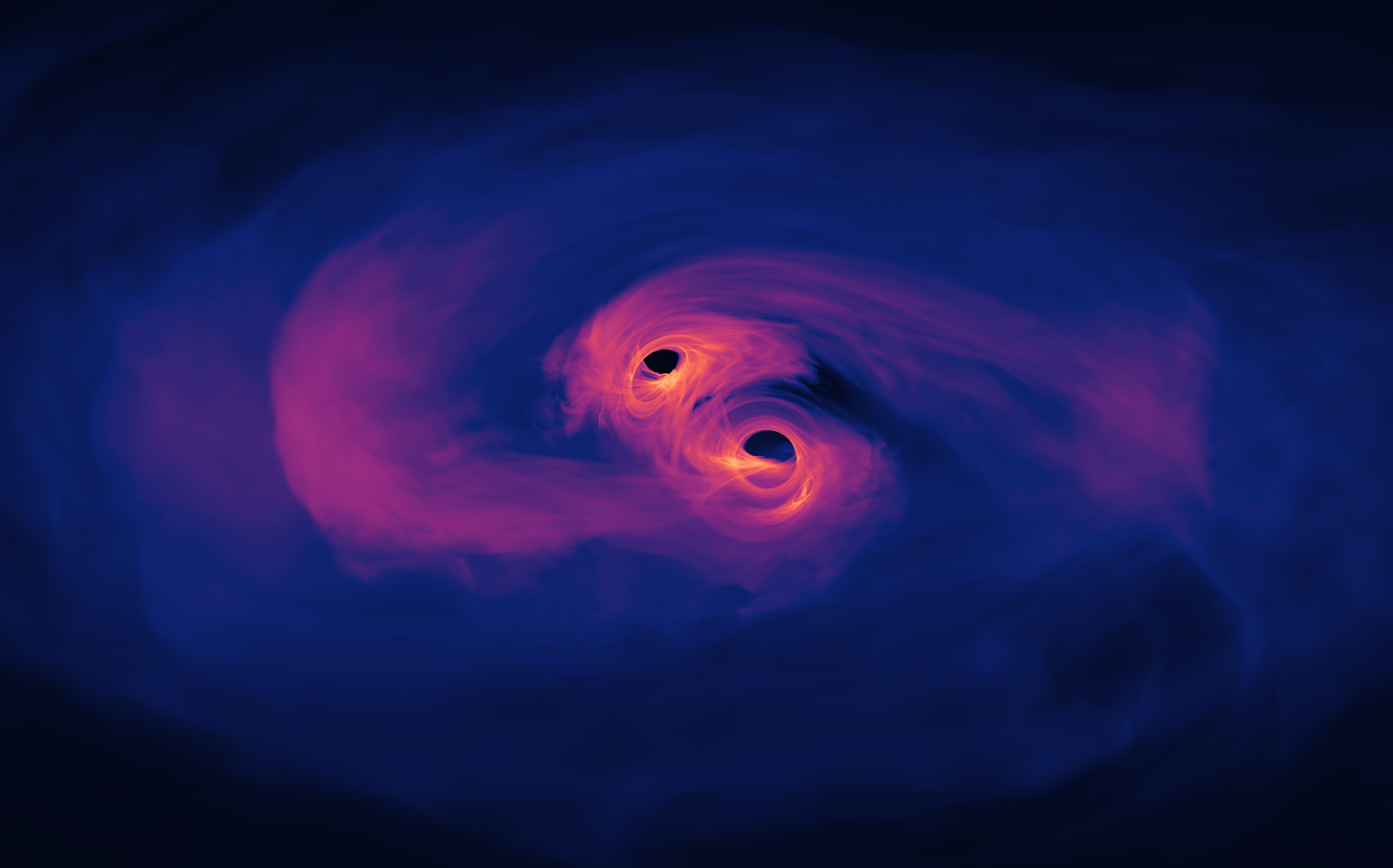
Gravitational waves were first theorized by Albert Einstein. They are created during events such as supermassive black hole mergers, or collisions between two black holes that are billion times bigger than our Sun. These collisions are so powerful that they create distortions in spacetime, known as gravitational waves.
Gravitational waves detectable by the LISA mission could also come from other distant systems including smaller stellar mass black holes orbiting supermassive black holes, known as Extreme Mass Ratio Inspirals (EMRIs).
What do Gravitational Waves tell us?
There are many astrophysical phenomena that are either very dim or completely invisible in any form of light that astronomy has relied on for 400 years. Gravitational waves are a powerful new probe of the Universe that uses gravity instead of light to take measure of dynamical astrophysical phenomena. Studying gravitational waves gives enormous potential for discovering the parts of the universe that are invisible by other means, such as black holes, the Big Bang, and other, as yet unknown, objects. LISA will complement our knowledge about the beginning, evolution and structure of our universe.
How are Gravitational Waves observed?

Opening the Gravitational Wave Window
On September 14, 2015, the Laser Interferometer Gravitational-wave Observatory (LIGO), a ground-based gravitational wave observatory, made history by detecting the first gravitational waves from the merger of two stellar mass black holes. Since then, LIGO and its European counterpart VIRGO, have announced the detection of numerous black hole systems and a few neutron star systems merging. In addition, in 2017 LIGO detected a neutron star merger which also produced light detected by dozens of telescopes on the ground and in space. This represented nothing less than the birth of an entirely new field of astronomy.
Ground Based Gravitational Wave Astronomy
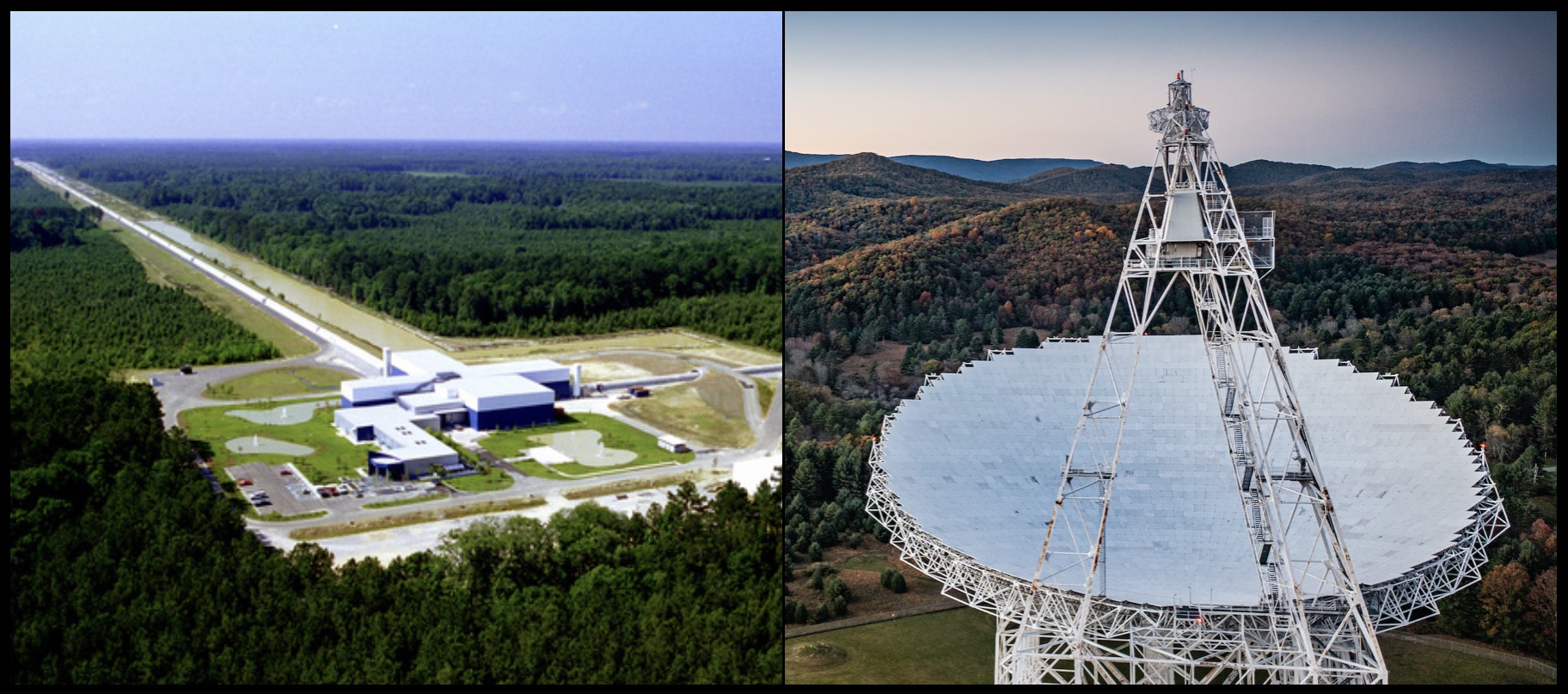
Some gravitational waves can be detected by ground-based interferometers including LIGO, VIRGO, KAGRA, and LIGO India. These facilities use lasers to detect the tiny ripples in spacetime caused by mergers of neutron stars and stellar-mass black holes. New kinds of events, such as nearby supernovae, may be detected as well. Localization of the source of the event requires a detection in two or more of these detectors, allowing triangulation of the region of the sky where the merger likely originated. Mergers are announced via Public Alerts that are available through an app or the General Coordinates Network (GCN).
Low-frequency Gravitational Waves
Some gravitational wave sources are not detectable by even the most advanced ground-based detectors. Gravitational waves at low frequencies have wavelengths larger than the Earth itself.
Pulsar Timing Arrays
Gravitational waves at very low frequencies have wavelengths of order tens of light years. Pulsar Timing Arrays (PTAs) use pulsars — rapidly rotating, highly magnetic neutron stars that emit beams of radio emission — as cosmic timekeepers. These experiments regularly observe radio pulsars to search for shifts in the pulse arrival times caused by the passage of gravitational waves between the pulsar and the telescope. The low-frequency gravitational waves being observed by PTAs are likely to have been produced by pairs of supermassive black holes in a binary system, formed after galaxy mergers.
However, some gravitational waves have frequencies between the gravitational waves detectable by ground-based instruments, and those being observed by pulsar timing arrays. Their wavelengths are too long to be seen by LIGO, but much shorter than the tens of light years being explored by the PTAs.
Space-based Interferometery
Deploying an antenna large enough to efficiently detect them requires going to space. LISA's three spacecraft will create an equilateral triangle in space and the paths between each pair of spacecraft, referred to as LISA's arms, will extend millions of miles. By measuring distance changes in these arms caused by passing gravitational waves, LISA will be able to measure their amplitude, direction and polarization. Astronomers will use this information to learn about the sources in this previously-unexplored region of the gravitational wave spectrum.
Why do we need to go to space?
A space-based configuration allows for an extremely large detector to study regions of the gravitational wave spectrum that are inaccessible from Earth.
A Different Frequency Range for Different Objects
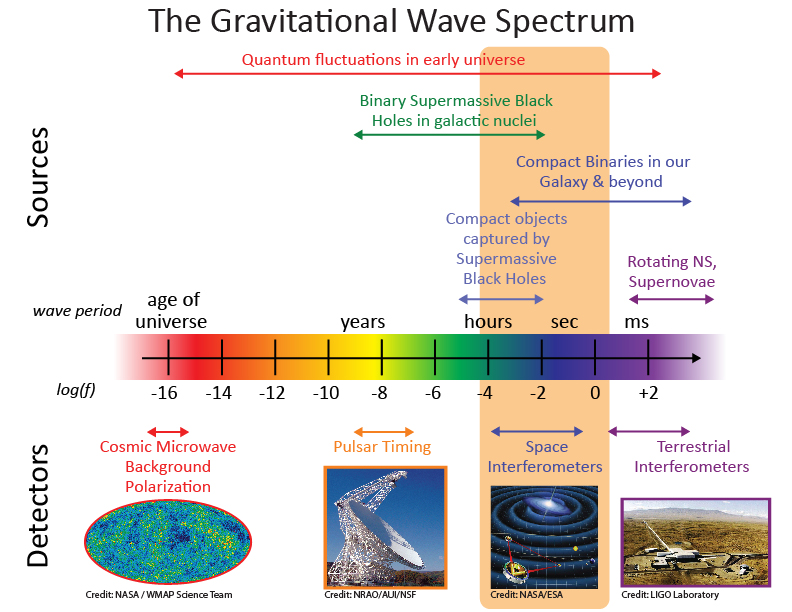
The gravitational wave spectrum covers a broad span of frequencies. LISA operates in the low frequency range, between 0.1 mHz and 1 Hz (compared to LIGO's frequency of 10 Hz to 1000 Hz). The difference means that the waves LISA is looking for have a much longer wavelength, corresponding to objects in much wider orbits and potentially much heavier than those that LIGO is searching for, opening up the detection realm to a wider range of gravitational wave sources.
LISA has three spacecraft that form an equilateral triangle in space where the sides of the triangle, also called LISA's "arms", extend about a million miles. Therefore, from space, LISA can avoid the noise from Earth and access regions of the spectrum that are inaccessible from Earth due to these extremely long arms. The gravitational wave sources that LISA would discover include ultra-compact binaries in our Galaxy, supermassive black hole mergers, and extreme mass ratio inspirals, among other exotic possibilities.
What is LISA?
LISA is a space-based gravitational wave detector constructed of three spacecraft
separated by millions of miles.
LISA's Size and Precision are Out of this World
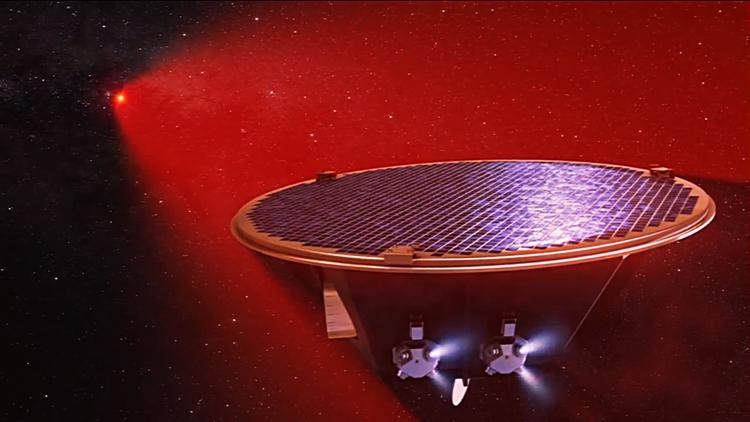
LISA consists of three spacecraft that are separated by millions of miles and trailing tens of millions of miles, more than one hundred times the distance to the Moon, behind the Earth as we orbit the Sun. These three spacecraft relay laser beams back and forth between the different spacecraft and the signals are combined to search for gravitational wave signatures that come from distortions of spacetime. We need a giant detector the size of the Sun to catch gravitational waves from orbiting black holes millions of times more massive than our Sun. NASA is a partner in the European Space Agency (ESA)-led mission, which is scheduled to launch in the mid-2030s and we are getting ready for it now!
How does LISA Detect Gravitational Waves?
Gravitational wave events will cause the three LISA spacecraft to shift slightly with respect to each other.
Catching Waves
A bit like the objects moving on the surface of a pond produce ripples and waves, massive objects moving in space distort the fabric of spacetime and produce gravitational waves. Some of these gravitational wave events will cause the three LISA spacecraft to shift slightly with respect to each other, as they "ride the gravitational waves", to produce a characteristic pattern in the combined laser beam signal that depends on the location and physical properties of the source.
LISA is Extremely High Precision
These signals are extremely small and require a very sensitive instrument to detect. For example, LISA aims to measure relative shifts in position that are less than the diameter of a helium nucleus over a distance of a million miles, or in technical terms: a strain of 1 part in 1020 at frequencies of about a millihertz.
The LISA Pathfinder Mission was a proof-of-concept mission to test and prove the technology needed for LISA's success.
What is LISA Pathfinder?
LISA Pathfinder Mission was a proof-of-concept mission for LISA.
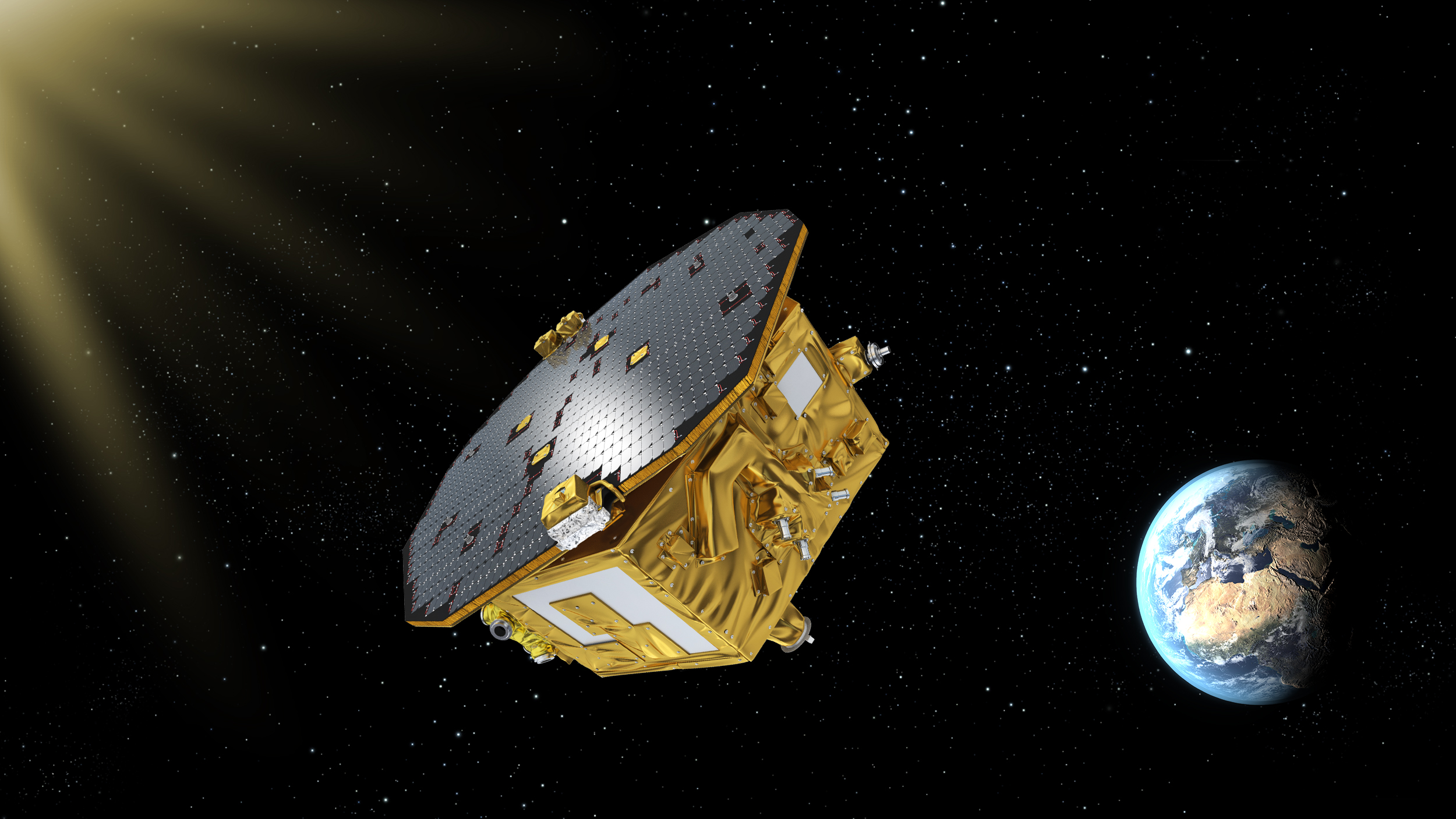
LISA Pathfinder Exceeded Expectations
LISA Pathfinder was launched on December 3, 2015 as a proof-of-concept that tests that the noise characteristics of free-floating test masses within the spacecraft are small enough compared to an expected gravitational wave signal. Completing its mission in July, 2017, LISA Pathfinder was able to reduce noise levels by a factor of 100 over its target requirements, demonstrating the performance needed for the full LISA mission.
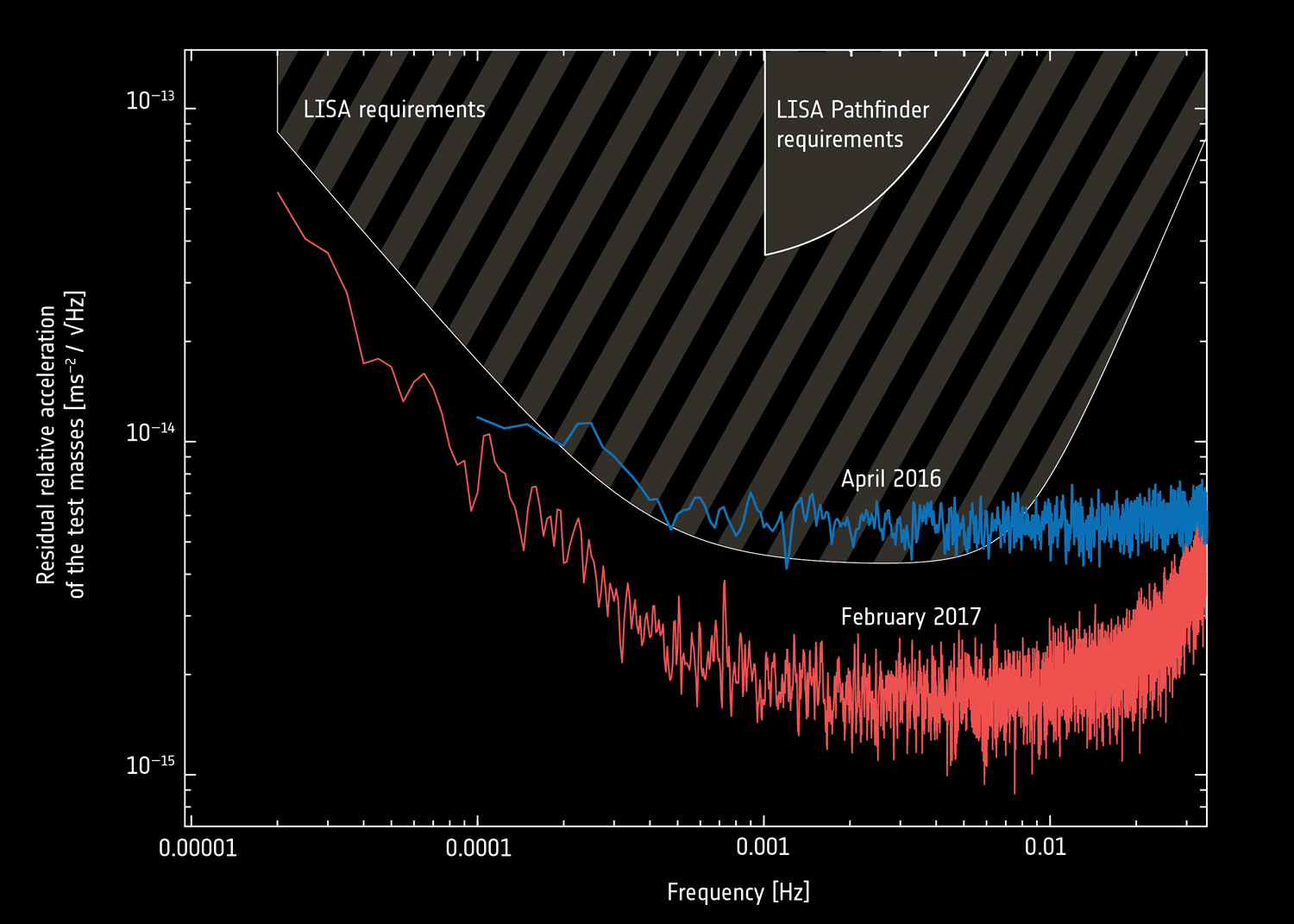
This plot shows the primary result from LISA Pathfinder's year and a half of science operations. The plot shows the measured level of imperfection from pure free-fall of the two gold-platinum test masses. The solid and hatched shaded areas show the designed level of performance for LISA Pathfinder and LISA respectively. The blue trace shows the preliminary result from Pathfinder, which was obtained just two months after science operations began. The red trace shows the final result, obtained in February 2017 after the instrument was tuned to improve performance. These measurements demonstrate that the technology developed for Pathfinder can be used as the basis for LISA's detection of gravitational waves.
Credit: ESA/LISA Pathfinder Collaboration.
Related Articles
Who's Involved?
Led by ESA, the project is a collaboration of ESA, NASA, and the global scientific community.
LISA is led by the European Space Agency (ESA) as a large-class mission in the Cosmic Visions Programme. ESA is responsible for the spacecraft, launch vehicle, operations, and overall mission design. Key elements of LISA’s instrumentation are provided by a collection of European National Agencies and NASA. The scientific community is organized through an international consortium of scientists that brings together global expertise in gravitational wave astronomy.
What is NASA's Role?
NASA will provide three key elements of the LISA instrumentation. The laser system will provide a stable light source for the interferometric measurements used to sense the presence of passing gravitational waves. Telescope systems will allow the laser light to be efficiently transmitted across the 2.5 million kilometer (1.6 million mile) distances between spacecraft. Charge management devices will reduce the buildup of electric charge on the freely-flying LISA test masses, preventing unwanted electrostatic disturbances.
In addition to its hardware deliverables, NASA is developing software to process the telemetry from the LISA constellation to identify and characterize individual gravitational wave signals. This data will be publicly available to the global scientific community to enable a wide array of scientific investigations.
In addition to these specific deliverables, NASA is supporting ESA with scientific and systems engineering expertise to ensure the integrated LISA system functions as a single scientific instrument sensitive to the subtle vibrations of spacetime.
For more informtation, read more about our activities.
How to Get Involved
Contact Points for LISA at NASA
- LISA Program Executive: Dr. Shahid Habib, NASA HQ
- LISA Program Scientist: Dr. Thomas Hams, NASA HQ
- LISA Project Manager: Mr. Terence Doiron, NASA GSFC
- LISA Project Scientist: Dr. James Ira Thorpe, NASA GSFC
For Scientists
- Gravitational Astrophysics Laboratory (GSFC 663)
- LISA Consortium
- Gravitational Wave Science Interest Group (GWSIG) (offsite)
Education and Outreach Resources
THE LISA AMBASSADORS PROGRAM
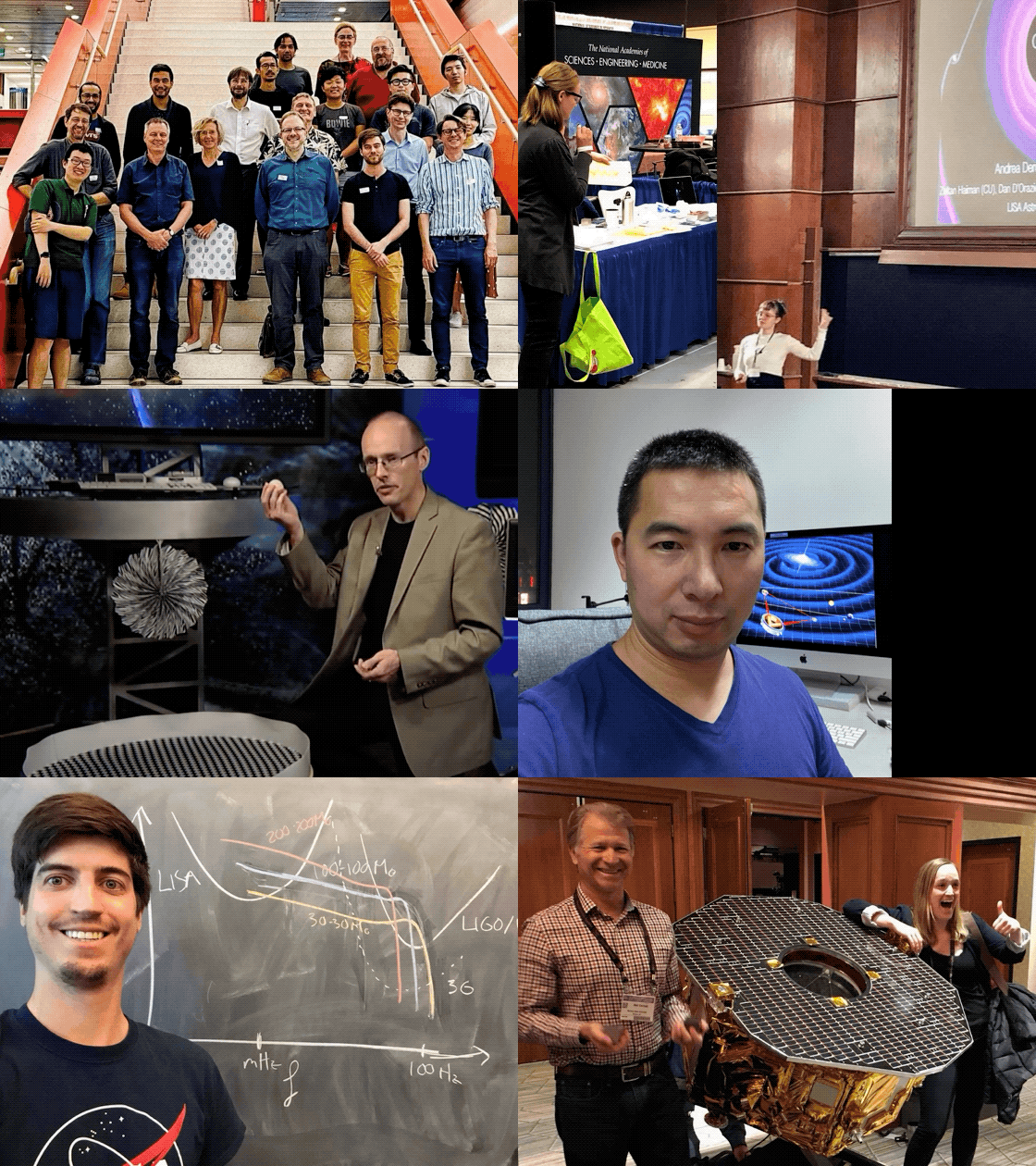
The LISA Ambassadors are current graduate students whose research interests lie in black hole physics, understanding the properties of supermassive black holes, gravitational wave astronomy, or related subjects. They receive in-depth training on how to communicate with high school students and the general public about the Laser Interferometer Space Antenna (LISA) mission and the importance of gravitational wave astrophysics. Ambassadors play an essential role in generating public interest in this exciting European Space Agency (ESA) and NASA mission.
Participating Institutions
- Marshall Space Flight Center: Dr. Tyson Littenberg
- University of Washington Bothell: Dr. Joey Shapiro Key
- Vanderbilt University: Dr.Kelly Holley-Bockelmann
- Yale University: Dr. Priya Natarajan
Links to gravitational wave education resources for teachers and students
- LISA Ambassadors (offsite)
- NASA Space Place (offsite)
- LIGO detection educator's guide [ PDF ]
Citizen Science Projects
- Einstein at Home (offsite)
- Gravity Spy (offsite)